
Plant Database Breadfruit
Artocarpus altilis · Moraceae (fig family)
A long-lived canopy tree that can feed a family for much of the year, and the anchor of many tropical food systems.
Breadfruit is one of the most productive food trees on Earth. A single healthy tree can bear well over a hundred starchy fruits a year, each weighing roughly 2–4 pounds, which can be steamed, baked, roasted, fried, or mashed much like potato. The fruit is rich in complex carbohydrates and fiber and is naturally gluten-free.
In a food forest, breadfruit is the long-term centerpiece. Everything else in a young guild protects and feeds it while it grows, and once it matures it shades the ground, drops leaves that build soil, and produces food for decades.
Breadfruit was domesticated in the western Pacific and is now grown throughout the tropics. The fruit is a staple food, and the tree also gives wood, latex used as a glue and caulking, and large leaves for wrapping.
Breadfruit is seedless, so new trees are grown from root shoots (suckers that sprout from surface roots), root cuttings, air layers, or tissue culture. Most home growers buy a young tree from a local nursery, a breadfruit festival tree sale, or a grower with healthy trees.
Breadfruit is the anchor of the starter guild. Around it: pigeon pea for nitrogen and mulch, banana on the windward side for shelter, papaya for fast fruit, and sweet potato covering the ground. As the canopy closes over the years, shade-loving greens like katuk and Okinawa spinach take over beneath it.
In Hawaiʻi the main season usually runs from mid-summer into fall, with some fruit at other times. Fruit is mature when the skin turns from bright green to yellow-green, the bumps smooth out, small cracks or dried sap appear on the surface, and the stem lightens. Harvest at least weekly in season.
All parts of the tree contain sticky white latex. Cut the stem close to the fruit and rest the fruit stem-end down for about an hour to let the sap drain. Mature fruit softens within 1–3 days at room temperature; cooked, cooled breadfruit freezes well.
General guidance for Kauaʻi; conditions vary by site. Check any new plant at plantpono.org before planting.
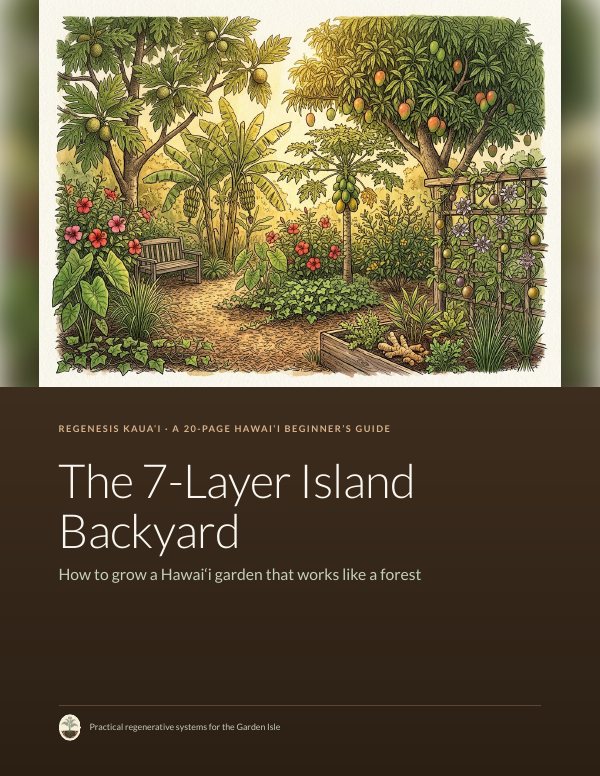
A 20-page guide to a Hawaiʻi garden that looks like a forest, free by email.