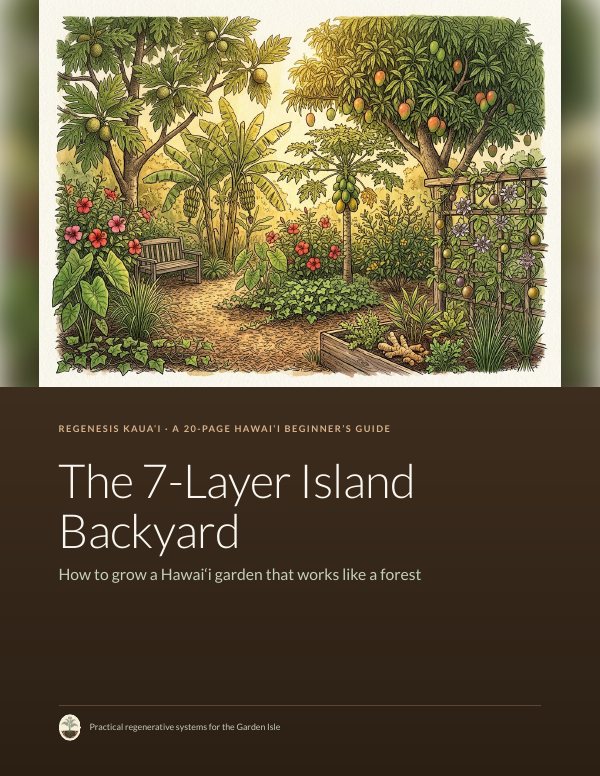
These principles guide the design of resilient, low-input systems. Each is paired with practical examples relevant to Kauaʻi’s climate, soils, and challenges.
The 12 permaculture design principles were developed by David Holmgren, co-originator of permaculture, and set out in his book Permaculture: Principles and Pathways Beyond Sustainability. Learn more at permacultureprinciples.com.
1 Observe and Interact
Spend time understanding your specific site: windward vs leeward rainfall, slope, existing vegetation, and microclimates. Kauaʻi’s conditions vary dramatically over short distances.
On Kauaʻi: Walk the land during and right after a heavy rain, and note where water enters, runs, pools, and leaves.
Capture rainwater, build soil organic matter, grow biomass, and use solar where appropriate. Heavy rainfall events make water storage and infiltration especially valuable.
On Kauaʻi: On drier leeward sites, catch roof water in tanks, mulch heavily, and build basins and half-moon berms around individual trees.
Cycle nutrients through compost, mulch, and animal integration where appropriate. Tropical climates accelerate decomposition.
On Kauaʻi: Keep organic “waste” on your land: compost food scraps, chop and drop prunings, and use yard trimmings as mulch instead of sending them away.
Start with the big picture (zones, water flow, sun, wind) before choosing individual plants.
On Kauaʻi: Place elements by how often you visit them: the kitchen garden and daily greens closest to the house (Zone 1), the larger food forest and staple crops farther out (Zone 3).
Use plant guilds and polycultures. Combine canopy trees, understory, nitrogen-fixers, and ground covers.
On Kauaʻi: A wet-side backyard guild: mountain apple or breadfruit with banana, pigeon pea, ginger, turmeric or katuk, and Okinawa spinach or sweet potato covering the ground.
Diverse plantings reduce risk from pests, disease, and weather extremes while providing multiple yields.
On Kauaʻi: Diverse plantings recover faster after storms and droughts than a single crop, and habitat for helpful insects prevents most pest outbreaks.
Make use of boundaries, windbreaks, riparian zones, and less-than-perfect soil.
On Kauaʻi: Turn boundaries into producers: gliricidia cuttings root into living fence posts, and strips of trees and shrubs along streams and gulches catch runoff and soil before they reach the water.
Design systems that can adapt to shifting rainfall patterns, stronger storms, and changing economic conditions.
On Kauaʻi: After a storm, replant fast growers. Banana, papaya, sweet potato, pigeon pea, and perennial greens produce food and shelter within months while slower trees recover.